Sunday, May 9, 2021

90s Soundtracks pt 2: Godmoney

 Christian punk for a movie about drug dealers


Godmoney is not a good movie. I rented it from Blockbuster in the late 90s and all I recall is a vague plot about a drug dealer stealing money. The acting is bad, the pacing is glacial, and beyond the soundtrack there’s really not much to recommend; it looks exactly like a low budget movie from a first-time filmmaker. Director Darren Doane got his start making music videos for Southern California punk bands, which didn’t call for a skill level much higher than “make the band look cool, maybe throw in some hot chicks”. He did a lot of videosA lot. He must have had a lot of favors owed to him, because the cast of Godmoney is mostly filled with band members with little to no acting experience, and it shows. As bad as it is, Doane’s filmography only got worse, becoming Kirk Cameron’s in-house director for his ultra-conservative right-wing film studio, making a troubling number of Michael Madsen-starring direct-to-video features, and filming the occasional documentary defending homophobes. I’m not sure when the switch was flicked between 42K (something about a magical necklace, ninjas, and babes) and Kirk’s Cameron’s Saving Christmas (the official title), but he did not reveal himself to be a secret auteur.

Christian entertainment runs deep in Doane’s work, so it’s not surprising that most of the bands here were signed to Tooth & Nail Records, hell this could act as a decent label primer for those interested. Tooth & Nail stood out from the cornier church lovin scene by having pretty high standards, signing decent bands and not beating Jesus over your head.

It’s worth noting that V2 Records, the label that actually released the soundtrack album, were hot shit for a little while. Founded by Richard Branson in 1996 following the sale of Virgin Records, V2 showed the same willingness to throw money at anything, with the era of $15.99 CDs fueling their singing spree. They made their bones with Moby’s massive albums Play and 18, but constant restructuring in the early 00s meant that by 2007 they were more of a line item on a financial spreadsheet than a functioning label. It still exists in name, but since Moby reclaimed the rights to his V2 albums, it’s indistinguishable from any number of constantly repackaged and resold publishing rights clearinghouses.

Without further ado, Godmoney: The Soundtrack, which despite being 22 tracks long barely cracks an hour runtime.

Pennywise “Peaceful Day”

These Epitaph mainstays always struck me as the jocks of the punk rock scene, spouting a generic PMA vibe but not weird enough to really interest me. I did own Full Circle in high school, and my cousin had Unknown Road, but as they’re kind of the template of generic Epitaph punk rock, they never really stuck with me. Guitarist Fletcher Dragge plays a drug dealer enforcer in Godmoney, but I mostly remember him in old interviews moaning about how the massive success of The Offspring’s Smash overwhelmed the label and he felt ignored.

MxPx “Doing Time”

Magnified Plaid managed to break out of the Christian Punk Rock ghetto by writing great songs and keeping their faith in the background. “Doing Time” is a quick little ode to youthful rebellion that goes down sweet with a catchy melody, but the theme seems to be that you can be a wild kid and wild adult and everything will be fine. Real punk rock shit right here. The band started out on Tooth & Nail but jumped to the majors in the post-Dookie feeding frenzy, and I clearly remember at the time Christian punks at my school saying they were good even if you weren’t a Believer.

Descendents “Lucky”

The SoCal legends were on a roll in 1997, with Milo back in the band and a recent album that managed to both capture the energy of their 90s run, and help them earn some dough that they never saw back then. “Lucky” was a b-side from the Everything Sucks album, but damn near one of the best tracks they’ve ever done. It probably got the boot to give the album a better balance of the serious songs and joke songs, both of which they excel at.

Stavesacre “Tranewreck”

Soundtrack albums have never been known for their good sequencing, but Godmoney is an anomaly in that it structures the tracklist around a few themes. After three tracks of aggressive pop-punk, it switches gears with four songs in the hardcore vein. Later on, the poppier tracks are grouped together, and the longer epics are at home at the end. Stavesacre are another Tooth & Nail band, and at less than 2 minutes this little bit of self-lacerating Christian hardcore doesn’t overstay its welcome, with something about “my carnal mind” heard in the din.

Chance 22 “Hollow”

After some internet sleuthing, it would appear this song is the only recorded evidence of Chance 22. Looking through the liner notes, the most I can find is that one of the members currently works for a guitar manufacturer. Sounds like they threw every popular angry male music genre in a blender, you got some nu metal guitar chugs, some rapping, and some off-key singing. Despite owning this CD for nearly a quarter century, I’ve made it all the way through this song once, to write this essay.

Stanford Prison Experiment “The Accomplice”

I gotta make a stand here: If you name your band Stanford Prison Experiment, you better sound a lot more intense than this grunge sounding track. The only bands allowed to use that name make grindcore and fit 12 songs on a 7”.

Rollins Band “Saying Goodbye Again”

Henry Rollins seems like a decent guy. I like his non fiction writing, his spoken word stuff is OK, and he’s a tireless supporter of new and extreme music, but I do not enjoy the music he makes. I’m not even a big fan of his Black Flag years, not even Damaged (for the record, the best Black Flag vocalist was Dez, the guy who didn’t want to be the singer and quickly moved to guitar). I think a lot of my ambivalence about Rollins Band has to do with how he recruited clearly overqualified musicians to play what amounted to dumbed down stoner rock. Eventually he did replace them with a dumbed down stoner rock band, but nothing he’s sung on has ever resonated with me. Despite that, “Saying Goodbye Again” is a pretty affecting track, one of several he wrote about seeing friend Joe Cole get shot and killed in front of him during a robbery.

Down By Law “Independence Day”

Some songs just unfold perfectly, with every note and word following the other in a way that hints at some divine force. Not God (though most of the bands on this comp might say that), but a force in the universe that connects us all. Dave Smalley’s post-Dag Nasty and All outfit probably had some other songs, but this brief celebration of seeing a band live is good enough to outshine the singer’s exceedingly iffy politics.

Farside “Hope You're Unhappy”

I thought this song was really deep in high school but damn, whiny dudes are the worst. Revelations Records had this side hustle of former hardcore bands going for a janglier alterna-rock thing, and while it was occasionally successful, more often than not it was a forgettable relic from the era.

Dance Hall Crashers “Nuisance”

I have one bit of trivia for Dance Hall Crashers, and it’s that they were formed by Tim Armstrong and Matt Freeman after Operation Ivy broke up. They cycled through a couple band’s worth of members, switched from dancehall to a pop punk/ska/sorta swing sound, and found success with two lead vocalists. They burned bright, but soon petered out around the turn of the century. In their heyday they were inescapable, with their legit roots in the punk scene and the fatc that they seemed to pop up on a lot of soundtracks (this isn’t the first song of theirs I’ll be covering in this series). The song’s fine, I mean you can’t have a 90s pop punk soundtrack without ska, it just wasn’t allowed back then.

Blink 182 “Voyeur”

Few things from Dude Ranch stood the test of time, but as a record of how middle class suburban white boys talked, it’s damn near a perfect time capsule. “Voyeur” is, conceptually, pretty bad, though to his credit Tom DeLonge always makes the creepy characters in his songs the butt of the joke, making his narrator in this song also witness his high school bully taking a shower (then again, he also knows his bully’s shower schedule, so there might be more to it).

AFI “Wake Up Call”

AFI made 3 albums of snotty punk before finding fame as the ur-Mall Goth band, though to ask some fans, they never got any better than songs like “I Wanna Get A Mohawk (But Mom Won't Let Me Get One)”. This song is from their 2nd album Very Proud of Ya, and it’s a pretty good litmus test to see if you’ll like any of their pre-Black Sails in the Sunset stuff.

Slick Shoes “Rusty”

Niche scenes have this weird phenomena where some bands are incredibly popular within them, and completely unknown to the rest of the world. Slick Shoes were another Tooth & Nail band with a massive following in their little sphere, enough to be a steady touring act for years and get their own greatest hits album. They sound like any number of pop punk bands of the era, but if you were looking for some pogoing with your fellowship, I bet they were awesome.

Guttermouth “A Day At The Office”

This is a band that doesn’t care about anything, which in 1997 made you a sort of court jester in the punk scene, with everyone waiting for the next crazy shit you’ll pull. Guttermouth’s singer Mark Adkins was a human Tasmanian Devil, leaving a trail of destruction in his wake (there’s a reason there’s a long list of former band members), but the music is surprisingly tuneful, owing more to country and western than the SoCal punk scene they came from.

Ten Foot Pole “It's Not Me”

Did you know their old singer was professional baseball player Scott Radinsky? I saw him play with his later band Pulley in Detroit with Voodoo Glow Skulls (see below). This has been Trivia Corner.

MxPx “Small Town Minds”

This is actually a medley, starting out with the listed track then moving to “First Class Mail”, which follows on the original album. For a band with strong Christian ties, a line like “She sees these things through dogma's narrow eyes” is surprisingly critical of the church.

Voodoo Glow Skulls “You Don't Have A Clue”

Read this story about the fake split Hickey made using an irate message someone from VGS left on their answering machine, it’s funnier than anything I can think of.

Guttermouth “Cut Off”

One last fun song before the brutal final sequence, enjoy it!

Fireside “Sucking The Dust”

The riff is sick, and the weird lyrics can be chalked up to the fact that the Swedish band didn’t speak English as a first language. This track probably goes along with some harrowing scene in the movie where the main character loses his girlfriend or something, I can’t remember. US fans probably know them from their opening track on seminal emo comp (Don’t Forget To) Breath, which is about as perfect an intro to 90s post-hardcore as you can ask for.

Living Sacrifice “Reject”

Christian Death Metal sounds like an oxymoron, but have you ever seen a crucifix? Clearly the most devout prefer a realistic depiction of Jesus’ torture and death. Living Sacrifice had an early run as a thrash act, but like a lot of metal bands in the late 90s, embraced groove metal (essentially nu metal minus the makeup). Most of their albums are on Tooth & Nail sub-label Solid State: yes, Christian Metal was so popular that Tooth & Nail needed a separate department to handle it.

Strife “Untitled”

It’s funny that the main character is played by Rick Rodney of militant straightedge band Strife, as his character gets mixed up with drug dealers. The band’s letter jacket logo, and the types of people I saw wearing their shirts, led me to believe they were a humourless chugga chugga hardcore band and… I wasn’t wrong. Bands that come across as self-help gurus always rubbed me the wrong way, but I do appreciate the cleaner sound and straightforward songwriting on their later album, Witness a Rebirth. Too many 90s hardcore bands tried to go all Industrial and it was never a good look.

Far “All Go Down”

This song is 8 minutes long, perfect for the end credits. Despite the credit to Far, it’s really a Jonah Matranga track, and a fairly accurate example of the music he’d make for the next few decades. Far had some pretty good songs, but getting wrapped up in the grunge/punk wave in the 90s rarely panned out in the long run. Nowadays “former punk dude goes solo acoustic” is a pretty normal path, but credit’s due to one of the first (but not the First). After Far disbanded, Jonah went the full DIY route, self-releasing a ton of home recordings, touring non-stop, and occasionally joining a full band.

Saturday, May 8, 2021

Oops! The Tour


Sunday, July 14, 2002

Detroit, Michigan

“You gotta see em live” always sounded like a hollow phrase, a way to demand someone appreciate the same music you do. If a song doesn’t move you from shitty car speakers, how could the same thing in person be any different?

I went to college in Bowling Green, Ohio, which is about 30 minutes from Toledo and about an hour from Ann Arbor and Detroit, where you can see the actual Hotel Yorba from 75 as you enter the city. I’d usually catch a ride with my friend JR to shows at the Magic Stick and C-Pop Gallery in the Motor City, but on this July weekend our driver was Jason Zeh, piloting his parent’s minivan.

Skin Graft records organized Oops! in 1994 as a semi-regular festival type event at Chicago’s legendary Lounge Ax venue, whose fertile post-rock, noise, etc scene made such an event popular. After touring sporadically as a multi-media event (with a theater troupe providing between-band skits), the 2002 edition was a cooperation with Load Records, who had grown into a cornerstone of the new skuzzy psychedelic noise coming out of its home state of Rhode Island.

I had been to shows at the (possible defunct) Magic Stick many times in the past, but always in the evening. Oops! The Tour had an early door to accommodate the long lineup, so the sun was not quite set as we rolled up. As we walked up the long flight of stairs to the show room, I saw something that went unnoticed up until then: The Magic Stick had a window. It was up where the wall met the ceiling, but the light pouring in really opened up the dank gray space, still permeated with the smell of years of cigarette smoke despite the recent indoor ban.

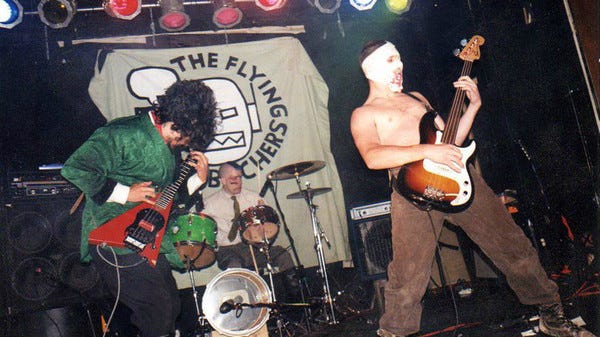
I believe The Flying Luttenbachers were playing when we walked in. The crowd was a little thin since it was early, but the drums/two bass Infection & Decline lineup of the jazz/noise/metal/etc group were playing like they had a gun to their heads. Drummer Weasel Walter was in his Skinhead Mutant phase, with a shaved head save for 2 locks of hair gelled up into devil horns (or maybe it was a mohawk?). One of the bassists was shirtless & wearing what I thought was a hockey mask, though images from the era prove it was fabric wrapped around his face. The other bassist had on this quasi-pirate costume probably cobbled together from thrift stores. The songs all ran into each other without any pauses or stage banter, except at one point the Pirate Bassist needed a second to adjust something and yelled “WAIT!” at his bandmates in the brief silence before the next song.

The Flying Luttenbacher’s 1996 album Revenge had made a Best Of list in an issue of Guitar World, so I was at least a little bit familiar with them. Their most recent album at the time got some decent airplay on my university’s radio station, but it just seemed like noisy jazz to me. In person, it was like shards of glass from three different broken mirrors that somehow fit together perfectly. There was virtuoso skill on display, but in the service of something other than showing off how good they were. To be honest it was a bit more than my brain could handle, but I was intrigued.

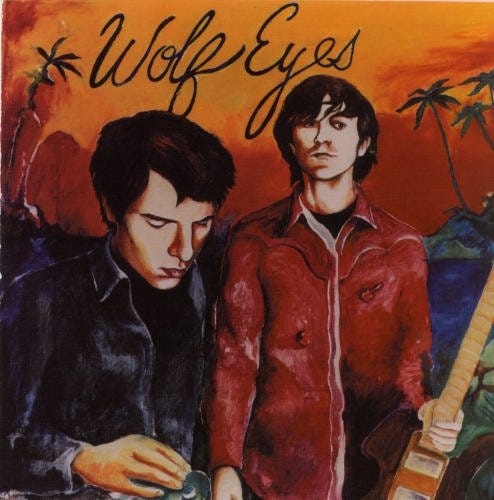
JR had played the self-titled Wolf Eyes CD in the car during trips to Ann Arbor, but my first reaction was What is this shit? It was just static! Was his stereo broken? He assured it me it was quality stuff, but I wasn’t sure. Live, the band was a full on punk rock explosion, with John Olson drenching the front row (including me) with beer during the first song. He had a suitcase full of oscillators open in front of him, Nate Young was moaning in a mic while adjusting a small modular synth setup, and Aaron Dilloway had a whole table of gadgets in front of him, along with a heavily modified guitar, and a contact mic in his mouth. The band lurched back and forth in a seasick sway, conjuring Dread and violence from their primitive setup. This wasn’t the kind of experimental music concert where you sat down and nodded in agreement to academic drones, this was a visceral show, with all the energy of a hardcore band. The frequencies started to re-arrange my DNA, and suddenly Wolf Eyes (and noise music in general) started to Make Sense.

Arab on Radar had a very strict onstage setup: 4 guys in matching Dickie’s outfits, lit by a row of harsh lamps they set up at the foot of the stage, facing back at them. The two guitar/bass/drums/vocals setup was the first quasi-standard Rock Band arrangement of the night, and in their own weird way they were the most straightforward band on the bill. They had a reputation as a No Wave noise band, but the serrated guitars and squirming vocals came off more like a mutant hardcore band than the art school derelicts of 1970s NYC. The drummer counted off each song in a high, squeaking voice, then the guitarists churned out dissonant repetitive riffs while the singer yelped about bodily functions over top.

The sound seemed to push each band member around like they were trapped in a viscous fluid: one jumped in place, another spun around in tight circles, another balanced on the lip of the stage, his guitar thrust out from his crotch in a mockery of Cock Rock moves. Then, and now, I admire it when bands take a typical instrument lineup and do something completely different with them. Arab on Radar did that, and I was equally entranced and confused, especially when the guitar players took a few moments between each song to tune what sounded like out-of-tune guitars.

Lightning Bolt used to play on the floor. That was their Thing for a long time, that and playing in front of a wall of amps, and the drummer/singer wearing a mask and pummeling his kit while the audience lurched around him. I was, at the time, completely unaware of this feature of their live show, which is why I was at the front of the stage as they started playing at the other end of the venue.

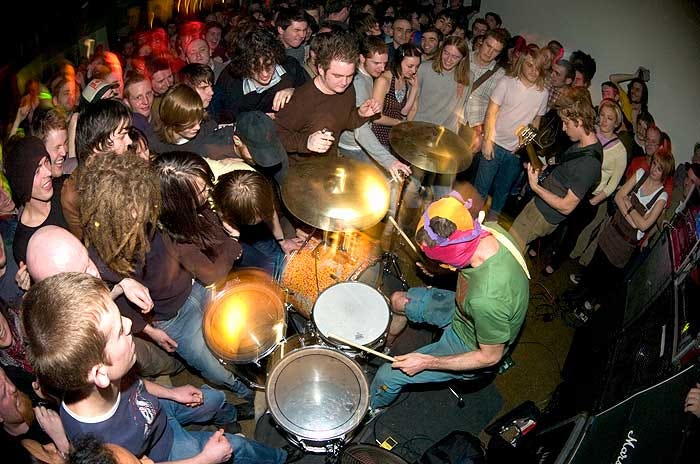
Diehards knew the routine, so while half of us were stuck back behind the sea of moshers, others were in the splash zone of Brian Chippendale’s drumsticks. When I say it was a sea of people, that is no hyperbole: it was a huge undifferentiated mass of arms and legs, barely holding together as the group lost their balance, regained it, then nearly toppled over again. Their album Ride the Skies was played a lot of college parties I went to, so I knew the music, but it would be another couple years before I saw Lightning Bolt properly. By properly I mean, in a sketchy unmarked warehouse in Detroit, nearly getting decapitated by the cymbal when the crowd pushed forward. Lightning Bolt plays on stages now.

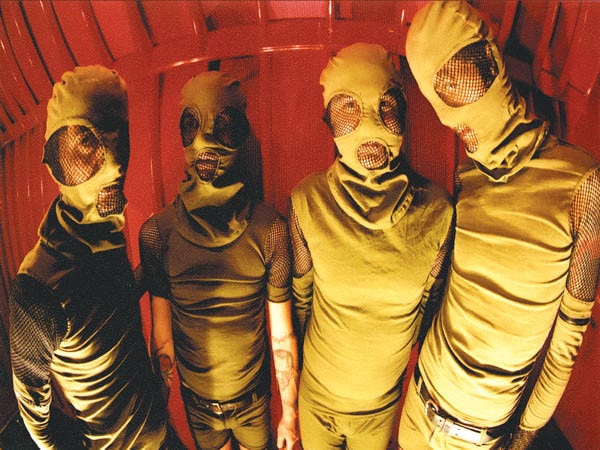
The Locust had a reputation in 2002, of being annoying hipsters, skinny Romulans with coke habits who could distribute Scene Points as they saw fit. After reading Justin Pearson’s book, it’s clear that reputation was projected on the San Diego band and had little basis in reality. The “coke mirror” merch that was so talked about back in those pre-Facebook message board days were really a box of blank promo makeup compacts one of the band members found, which was the perfect size and shape to affix their already-made band stickers. They were an easy target for the insecure to blame for something new infiltrating their hermetically sealed Scene, which is where the reputation became reality: They really hated the hardcore scene, and were willing to go to absurd lengths to try something, anything, to make it interesting. Weird stage clothes, adding a keyboard player, having songs that usually hovered around the 30 second mark, anything. They were trying to destroy music and build it up into something new, much to the chagrin of audiences expecting more chugga-chugga Victory Records hardcore.

This was their Bug Suit era, where each member wore matching nylon costumes with mesh masks. The second Lightning Bolt was done playing, The Locust launched into their first song, and the crowd from the other end of the floor surged forward towards us near the stage. You just had to kind of go with the flow, since any escape was blocked by people, the stage, or the mosh pit that had opened up behind us. Each song blurred into the next, punctuated with some snappy crowd work. Their songs all mostly sounded the same, so a request for “Dog Without A Collar (Run Over Red Rover)” would be quickly answered with “we already played that one” before launching into the next song.

After that show, the noisy, chaotic, and abstract music I didn’t understand suddenly made sense. It was most likely the way it used the same energy in punk rock and hardcore for artier, weirder ends. This was a lineup of bands trying to make music that no one had heard before, to push the limits of what was physically possible, and what people would stand to listen to. The fact that I was in a good venue with likeminded people also helped; the atmosphere was chaotic but fun. After that, a whole new world of music opened up for me, and for that I’m grateful. Maybe you do gotta see em live, maaaaan.

90s Soundtracks pt 1: Tommy Boy


The 90s had some truly bizarre movie soundtrack albums, where the idea of “a collection of songs from the movie” went out the window, and instead a cross section of disparate genres, label synergy, and songs that didn’t even appear in the film were collected into what amounted to expensive mixtapes. In the first of a series, I’m going deep into these weird relics from the CD era, when Brandy rubbed shoulders with Sunny Day Real Estate, and the best Green Day song was buried in the soundtrack to a little-seen (but high quality) teen comedy. 

More movie soundtracks should have dialogue tracks between songs, I mean that’s why the teenage me bought this, the soundtrack to the first (and best) Farley/Spade vehicle, which was a ubiquitous presence on cable tv in the 90s. “Fat Guy in a Little Coat” comes up every winter when I’m getting ready to leave the house, and “malted hops and bong resin” pops into my head with curious regularity. 

The songs on the album range from rap rock to college rock to pop punk, with a soft rock classic and 1973 Eurovision runner-up thrown in for kicks. For a movie that includes a scene where Rob Lowe is electrocuted via urination, there isn’t much filler, and only 1 band that seems to have completely disappeared.

Phunk Junkeez “I Love It Loud (Injected Mix)"

Is this a good song? No. For the movie, when it introduces Tommy at a frat party, is it perfect? Absolutely. Phunk Junkeez predate the mainstream explosion of rap rock, but their obnoxious sound is the perfect soundtrack for white boys to drink to. It’s really a cover of Kiss’s Creatures of the Night song of the same name, a concert staple despite the album failing to bring KISS back to their former glory. What strikes me the most about this song now is how the singer’s vocals are incredibly compressed and pushed forward in the mix, to the point where it’s almost like ASMR. I can almost hear the saliva in his mouth. Distasteful.

"Graduation"

I took 4.5 years to graduate college (due to a semester spent abroad where I earned almost no credits) so this one stings a little.

Paul Westerberg "Silver Naked Ladies"

I wonder if even this song’s author wondered why a trad rock throwback was chosen by the music supervisor, maybe it just worked for the movie’s road trip scenes? The rest of Paul Westerberg’s debut solo album (after All Shook Down, which was a solo album in everything but name) is fairly laid back country-tinged rock, with the exception of single “World Class Fad”, an exercise in keeping The Replacements fanbase happy. The follow-up album, Eventually, is so named because evidently back then taking 3 years between albums was cause for concern.

"Lalaluukee"

If you’ve never done this with your head close to a fan, you’re a liar.

Primal Scream "Call On Me"

There’s a couple distinct eras of Primal Scream: the jangly beginning, the rave-influenced Screamadelica classic, and this, their poorly-received attempt at throwback rock n roll. The album, Give Out But Don’t Give In, is in the pantheon of Hated Brit Rock Follow Ups, along with The Stone Roses Second Coming, lambasted not only for their stylistic change, but for the baffling choice to abandon a successful formula to indulge their love of American rock n roll. The big difference between Mick & Co and Primal Scream is that The Rolling Stones were legitimate scumbags, and Primal Scream seem like fairly well-behaved boys. The band would return to the sample-based sound with Vanishing Point, but the common thread throughout their career is that Bobby Gillespie’s lyrics have always been pretty bad.

"How Do I Look?"

To be honest I cannot remember this quote. Forward!

The Goo Goo Dolls "Wait for the Blackout"

While it was years before I heard The Damned’s original, I still prefer Goo Goo Dolls stripped down cover, full of the buzzing guitars that the original band had nearly abandoned at this point in their embrace of a Goth Rock sound. While The Damned’s studio experiments would eventually bear fruit with 1996s Anything, “Blackout” is choked with unnecessary overdubs, including a particularly annoying acoustic guitar. The Goo Goo Dolls play it like a Buzzcocks song, which reveals it to be an aching ode to love, not the lusty horror vibe Dave Vanian was going for.

"Bong Resin" (This isn’t on YouTube for some bizarre reason)

To be fair, Tommy’s brain cells were just dead. A head full of malted hops and bong resin would probably make him smarter.

Shaw Blades "My Hallucination"

What is this boomer nonsense? Tommy Shaw (Styx) and Jack Blades (Night Ranger) were moonlighting from Damn Yankees long enough to eke out two albums, including this tour through white middle class suburban Classic Rock, like “We Didn’t Start the Fire” without a sliver of self-awareness (Billy Joel’s song is also unaware, but only at his denial of Boomer’s complicity in the century’s atrocities). They threw in the riff to “Sunshine of Your Love” just to make me hate it even more.

Seven Day Diary "Air"

Every major label soundtrack has a couple bands that came and went without much notice, forever recorded for posterity between much more successful acts. Besides some college radio airplay and a lone major-label full-length, Seven Day Diary didn’t make much of an impact, though at the time their revved up melodic alternative rock sound was so common that it was easy for them to fall in the cracks.

"Fat Guy In Little Coat"

I say this every time I put on a coat. Every time. Since 1995. I am nothing if not predicable.

The Carpenters "Superstar"

Delaney and Bonnie’s oft-covered standard is a soundtrack staple, though I’d forgotten just how depressing the verses are, wallowing in despair until that giant chorus opens up. Soft Rock has a pretty dark undercurrent that deserves further investigation, not just because this song ended up serving as an epitaph for Karen Carpenter’s untimely death. Bonus fun fact: Sonic Youth’s version pops up on its fair share of soundtracks too, with the added pleasure of knowing Richard Carpenter singled it out for particular derision.

"Jerk Motel"

I say “Buddy Whack It” probably more often than is healthy.

Soul Coughing "Is Chicago, Is Not Chicago"

Besides the movie’s climax taking place in Chicago, there’s not much reason for this song to appear here. To be honest, Mike Doughty’s treatment of his former bandmates kind of soured me on a lot of his work. Onward!

"My Pretty Little Pet"

This scene starts off as a parody of the famous diner scene in Five Easy Pieces, but transcends mockery by using it as a springboard for Tommy to finally figure out what his skills are as a salesman.

Dexys Midnight Runners "Come On Eileen"

This song isn’t really fair to evaluate, it’d be like criticizing ancient Roman architecture, or saying the Washington Monument’s too tall. In the pantheon of Western Popular Music, “Come On Eileen” is just there. It existed before us and it’ll exist after us, for eternity, regardless of fads or well-intentioned ska-punk covers. What do you expect me to do, make fun of it? I’m sure there’s a few misguided souls out there who hate this song, but they just hate the situation they first heard it, or the person it reminds them of. The song is unimpeachable. Poor, poor Johnny Ray.

R.E.M. "It's the End of the World as We Know It (And I Feel Fine)"

Coming back to “We Didn’t Start the Fire”, Michael Stipe takes us on a different kind of journey through the problems of the late 20th century, hitting the highlights of the Cold War, Iran Contra scandal, and uh... celebrities whose initials are L.B. The McCarthyism reference is actually the 2nd on the album this originally appears on, with “Exhuming McCarthy” also despairing how the political climate in the 1980’s wasn’t much different from the 1950’s. R.E.M. are an institution now, so it’s easy to forget how political they got during their middle years. They started out with environmental songs like “Fall on Me” and “Cuyahoga” on Life’s Rich Pageant, quickly moving onto the more concrete protest songs on Document, culminating with Green’s bitter odes like “Orange Crush”. The band rarely got so boldly political in their songwriting after that, though they used the old longbox design of follow-up Out of Time to incorporate a Rock the Vote postcard asking the buyer’s senator to support a bill that allowed people to register to vote at the DMV, a bill that, as anyone who’s gotten a driver’s license can attest, passed.

Mocedades "Eres Tú"

The Eurovision Song Contest isn’t a big deal in America, but for the rest of the Western world it’s appointment television, with country’s respect at stake. This 1973 runner-up was a surprise crossover hit in the US, when its dulcet tones fit snugly with the Formica countertops, sunken living rooms, and Naugahyde couches of middle America. In the movie it’s part of the road-trip montage as the guys race the clock to get to Chicago. I think the humor was supposed to be that they both knew the words, but it was a big hit in it’s day, why wouldn’t they?

"Housekeeping"

Yes, this is dumb, but who cares. Richard is a shithead, but he gets his comeuppance in having to see Tommy in his underwear.

Smoking Popes "My Lucky Day"

My first memory of this overlooked pop-punk band was a Guitar World sidebar about how the band was 3 brothers and their friend on drums, and 2 of the brothers were these huge intimidating guys. The 3rd brother, Josh Caterer, helped make the blueprint for the type of ultra-melodic pop punk that got real popular in the early 00s; unfortunately, the Smoking Popes were about 5 years too early. Signed during the earlier punk boom of Green Day & Rancid, the Popes didn’t have their snarl, just the overdriven guitars and fast tempos. Josh Caterer’s vocals reach back to the early days of pop music, as exemplified in their album of show tune covers, The Party’s Over. That album also served as their goodbye to Capitol Records, who rejected the album and released the band from their contract. After hopping around some indies, and Josh Caterer’s departure, the band re-formed and found a much more accommodating home in pop-punk mainstay Asian Man Records.

Lost Videos of 120 Minutes

 In the mid-to-late 90s, I spent most Sunday nights waiting until I was about to fall asleep to hit record on the VCR in the family room. 120 Minutes, MTV’s long running lone outpost of indie music, aired midnight to 2am, barring LoveLine or Road Rules reruns. I didn’t trust the VCR to actually start recording when I programmed it, so I set it to record in EP mode (remember that?) and let it run from around 11pm til whenever the tape ran out in the wee hours. Eventually I amassed a small collection of episodes, though even at the time I knew most only had 1 or 2 videos worth re-watching. The excitement came in not knowing what was coming next: would it be an overhyped UK band, or another fucking 311 video? It must have been easy to get touring bands to the downtown Manhattan studio, as Sebadoh, Hum, Buffalo Tom, and the Butthole Surfers (among many others) showed up for interviews, performances, and/or hosting entire episodes. 

There’s videos still burned into my memory, usually from bands that rarely got MTV airplay. The endless memory bank of YouTube saved them for posterity, blurry VHS quality and all. Honestly it would be weird to see these videos in HD, as the tracking issues and fuzzy resolution are part of the memory. Here’s some videos I remember, with my memories of watching them, and some info on what happened to these groups after a brief shot at glory in the early ante meridiem (many thanks to The 120 Minutes Archive, crucial to jogging my memory https://120minutes.tylerc.com/) 

The Connells “Maybe”

October 20, 1996

The Connells had a big hit overseas with “74 75”, but despite hitting the Top 20 in the US, this North Carolina band never really leveled up, even after almost two decades of grinding it out. I’m not sure a video based on Deliverance was going to push them over the top, but they sure look like they had fun filming it. Back when they started, this type of jangly, R.E.M.-indebted rock, with little to no trace of its punk roots, was called College Rock. It was never totally palatable to fans of mainstream rock, nor rough and noisy enough for that day’s Indie Rock crowd, which was closer to Black Flag than The Replacements. Singing to TVT didn’t help much, as the former TeleVision Tunes label has a well documented history of screwing over bands. Maybe one day a label like fellow North Caroliners Merge will do a box set that covers their post-punk beginnings to their final shot at stardom.  

Howlin’ Maggie “I’m a Slut”

September 8, 1996

Living in the Dayton suburbs in 1996 exposed me to more of the southwest Ohio music scene than I normally would have, with Guided by Voices unavoidable and The Afghan Whigs repping Cincinnati. I used to hear this track on the local alterna-rock radio station (The Edge 103.9) pretty regularly, though usually in the late hours, to avoid offending the sensibilities of corn fed Midwesterners. Main man Happy Chichester’s professional relationship with Greg Dulli probably helped with getting signed to Columbia, and after Howlin’ Maggie disbanded he went on to join Dulli in The Twilight Singers. I come back to this song maybe once a year, since it is catchy as hell and has more attitude in one song that most bands can muster for a whole album. 

Booth and the Bad Angel “I Believe” 

August 11, 1996

Did you know Tim Booth from James did an album with composer Angelo Badamenti? I’d completely forgotten about this before researching this article. Turns out Googling “Tim Booth rolling in flowers” bore fruit! Besides the string section, I’m not sure how much Badamenti I hear in this, essentially a pretty standard jangly mid-90s alternative rock song. Despite the massive success of “Laid”, James always had an experimental streak, with a bunch of records produced by Brian Eno to their credit. Anyone looking for Twin Peaks style soundscapes will be disappointed with the rest of the album, which alternates upbeat numbers with moodier midtempo songs that flirt with Adult Contemporary. I remember Matt Pinfield being pretty excited about this video but I was not. Angelo Badamenti spends the video perched on a building miming as a conductor, and Tim Booth rolls around in a field of flowers. I’m just now noticing that the song is mostly the chorus over and over. 

Metal Molly “Orange”

October 20, 1996

This Belgian trio got caught up in the post-Nirvana grunge wave, but I hear a lot more of the dissonant indie pop of Shudder To Think in their sound, especially the atonal hook that anchors the song. Metal Molly were a little too silly for the dour, authenticity-obsessed 90s, and not quite silly enough to appeal to Ween fans. They put out one more album in 2000 before going on hiatus, and their brief run is a good reminder of how popular guitar-based rock used to be. The boundaries between pop, rock, rap, etc have blurred so much that it’s hard to remember when the only game in town was a guitar/bass/drum lineup.

Prick “Animal” 

September 29, 1996 (120 Minutes of Nothing)

This video aired 2 years earlier when the album came out, but was revisited for this special “120 Minutes of Nothing”, which turned out to be a fairly normal episode, with some remote interviews during the Nothing Records showcase concert. After the massive success of The Downward Spiral, Interscope gave Trent Reznor a blank check for his boutique label, Nothing. He did some good with it, like giving Autechre better US distribution, and some pretty middling, like helping out former Lucky Pierre bandmate Kevin McMahon with his new project. Prick does have a small but loyal fanbase (one of my high school friends was, and remains, an ardent supporter), but it sounds to me like a bit of bandwagon jumping, wearing Industrial music like a costume. Have you heard Lucky Pierre, anyways? Their jittery, noisy new wave would have been a big hit in the Meet Me In the Bathroom 00s blog rock era. The video takes place in a big metal silo, which was strangely ubiquitous in the 90s (see also: “Warped” by Red Hot Chili Peppers). Having people dress up as animals is a sorta neat twist, though I’d pay to see the Jack Hannah type of backstage shenanigans that went on when the real animals showed up. 

Requiem for Load


Quarantine has left us all with a lot of downtime, and like many, I’m looking for something comforting in music, something familiar. Like most times when I’m feeling down and lost, I look to the music of my youth for something to hold onto. Not that much of the music I liked in my teens is objectively Good: Led Zeppelin IV may be their crowning achievement, but it wasn’t until they stopped ripping off old blues musicians and embraced knotty, math rock levels of composition with Presence did the band finally start to sound like more than the sum of their parts.

The same goes for Metallica: While The Big Three (Ride the Lightning, Master of Puppets, and ...And Justice for All) are the Metallica of my youth, they’re essentially three attempts at the same formula, right down to the track listing and style of each song. All three have The Fast Opening Song, followed by the Title Track, then a comparatively slower ballad, an instrumental, and a final thrash track. 80s Metallica was predictable in the best way, since metalheads are a fickle bunch and can only handle a small variety of the same heavy metal.

While 1991’s The Black Album (or Metallica, if you prefer to be a pedantic asshole about it) may have seemed like a sea change at the time, it was still Metallica, albeit in slightly different ratios. Their songs always had mid-tempo sections, even if they were bookended with tremolo-picked thrash riffs. The self-titled album just took out the really fast parts, used 1 or 2 riffs per song instead of a dozen, and dropped their tendency to slightly alter the riffs each time it was repeated. The songs were still long, but plodded through extra choruses instead of adding an acoustic interlude. At the time I was still enamored with Fast Metallica, and the Black Album seemed like a concession to the mainstream. Teenagers are, and remain, idiots.

So just imagine my reaction when a new Metallica album was announced in 1996, during my freshman year of high school. The cover was covered in blood, reminding me more of Cannibal Corpse covers than the iconic art of Metallica. Load was a funny title, but the cover had blood! Their logo was changed a little, but hey they’d had it since before I was born, time to switch it up a little.

The PR surge leading up to the release was unavoidable, what with their short hair, edgy Anton Corbijn photos, nipple piercings, and tattoos. The Black Album was austere, severe, and five years later they put an actual cumshot on the cover. In hindsight it does seem odd that they felt the need to have this Very Nineties Grunge look when past Metallica songs had covered such lighthearted fare as state executions, giant monsters, nuclear annihilation, and infanticide. They didn’t even use the most controversial Andres Serrano piece!

The funniest of my Load memories is Alice in Chains’ bassist Mike Inez writing "Friends Don't Let Friends Get Friends Haircuts...” on his instrument in reaction to seeing Metallica in the front row of their Unplugged show, taped just a few months before Load was released. Don’t worry, Alice in Chains will come up later. For now… patience.

In retrospect, the “failure” (if you can call a multi-platinum album a failure) of Load comes down more to marketing than music. Myself and the rest of the young, white, socially inept males that made up most of Metallica’s fanbase really weren’t ready for a change in the Helvetica typeset liner notes, let alone anything that sounded much different from the albums they’d been releasing the preceding 13 years.

I bought Load at Media Play, a relic of the 90s which, even at the time, seemed like a losing proposition. Hitting play on my Discman back then, 14 year old me was not enamored with this New Metallica. The thing is, for all the glamor shots and music videos suffused with the typical mid-90s MTV aesthetic, the music doesn’t stray far from the regular Metallica formula. The biggest difference being, to my now mature and understanding ears, is that they started to write Songs instead of linking riffs together until they resembled a song. The band Converge call this “Part-y songs”, referring to their early days of joining unrelated riffs together like train cars until it seemed like a song. Mastodon also did this in their early days, describing it as “dumping riffs on the floor and sifting through them until a song emerged”. Both bands are still around, and their longevity has as much to do with their eventual embrace of traditional verse/chorus song forms as the relative quality of their output.

Alice in Chains may have perfected the typical Grunge Band vibe, but even their heaviest tracks started out as songs you can play on an acoustic guitar. Not only did Metallica start to follow this songwriting path with Load, they were even known to cover “Them Bones” live, one of my favorite Alice in Chains songs. For all of Layne Staley’s self-lacerating lyrics, “Them Bones” is structured like a typical blues song, despite the riff being in ⅞. Building a song from the ground up so that it can stand on its own without any ornamentation is the deceptively difficult part of songwriting, which Metallica took in some pretty good directions, but not without some bum parts.

So what does Load sound like? Mostly the boogie end of Black Sabbath, bluesy 70s Southern Rock, with a dollop of grunge angst slathered over the whole mess. And it is a mess, don’t think I’m lavishing praise on some unappreciated classic. Metallica are incapable of playing with the kind of behind-the-beat swing that makes swamp rock work, so tracks like “Poor Twisted Me” come across like a weak parody instead of a tribute.

The album, like most popular music in the mid-90s, stretched the limitations of CD capacity—The album’s shrink wrap even came with a sticker boasting of its 78:59 runtime! The following years ReLoad ran a brief 76 minutes, with fewer memorable tracks and with the general feeling that they should have been relegated to B-side status. Few of the songs on either album needed to break the 3 minute mark, though the shortest by far is just a hair under 4 minutes, and most hover around 5 to 6 minutes.

Starting out your first album in 5 years with 5 minutes of generic riffage called “Ain’t My Bitch” wasn’t a good call, let’s get that out there. Especially for a band that boasted of not bending to the same chauvinistic “oh baby baby” lyrics of hair metal, it seemed completely out of character. It’s lyrically puerile, but even worse was the first of many uses of structuring the song with a false ending before playing the opening riff again. Besides stretching the song out, nothing is gained from this, it’s just filling up more 1s and 0s on the CD. “2x4” fares slightly better, with a pentatonic riff straight out of the Tony Iommi playbook, but again with some pretty dumb lyrics.

However, the next four tracks are the most consistent 20 minutes the band would ever create, oddly enough by foregrounding some of the most despairing lyrics James Hetfield has ever written. He’s never been known as a really positive guy, with his well-documented childhood riddled with tragedy, but on this record he managed to use some sort of alchemy to turn his pain into something approaching the sublime. Either it was producer Bob Rock’s search for perfection, or his own search for an outlet for his pain, but Hetfield’s lyrics were never better than on Load, and sadly they never got any better in the records that came after.

“The House Jack Built”, an unflinching look at alcohol addiction (which Hetfield would go to rehab for twice in the next 20 years), uses the metaphor of the body as a decaying house. Lyrical quality in metal is a pretty low bar to pass, but lines like “Is that the moon or just a light that lights this dead-end street?” elevate it above the era’s kings of self-loathing, while introducing the concept of a forgiving light that Hetfield would return to later.

“Until it Sleeps” was the lead single, and its video (directed by the ubiquitous Samuel Bayer) is a hellscape based on Hieronymus Bosch paintings (which aren’t quite as spooky when rendered as giant Muppets). The video is full of out-of-focus shots, grotesque extras, and those flashes from starting a film camera with the aperture open; basically every 90s cliche crammed together. It’s a shame that now the video looks hilariously dated, since the song is a journey through Hetfield’s early experiences with his mother’s death and the impact it had on his life, including his inability to form lasting relationships. It’s one of the most un-Metallica sounding songs on the album, and an odd choice to re-introduce the band to the world, but maybe the best way to learn to swim is to jump into the deep end first. Metallica were never this tuneful, using fairly standard alternative rock dynamics to deliver lyrics of such self-hatred that it puts many of the misery purveyors of the time to shame.

While eagle-eyed fans may have noticed the album contains a sequel to the Black Album’s “The Unforgiven”, they may have gotten just as much a sense of deja vu from “King Nothing”, a bald-faced rewrite of “Enter Sandman”, right down to the way the pre-chorus modulates up one step. That’s not a knock on it; many bands have based entire careers on writing the same song over and over again, and “Enter Sandman” is as good a song as any to self-plagiarize. “King Nothing” would have been an obvious choice for a lead single, and probably would have changed the entire way the album was received, but this is a band that loves shooting itself in the foot: witness the dry, brittle production of ...And Justice for All that came before, or the tin can drum sound and weak songwriting of St Anger that came after.

The next track, “Hero of the Day”, is not just the best song Metallica has ever written, but one of the best rock songs of the 90s. It may start off with a folky sounding clean guitar riff, but it builds as the song goes on, until busting out the double bass pedals and palm-muted riffs the band used to deploy in every song. It’s mostly in a major key, a big departure for a band that used to use the flat fifth tritone in nearly every song, creating havoc for lead guitarist Kirk Hammett when he tried to figure out how to solo over it.

It’s probably the quarantine’s pressure on my brittle psyche, but a line like “The window burns to light the way back home/A light that warms, no matter where they've gone” hits me in the gut. Using light as a metaphor for hope is some English 101 shit, but it’s explored in ways that elevate it way above their metal peers, with lines like “still the window burns” and “keepers of the flame” illustrating the idea of persevering through even the toughest circumstances.

With current world events pressing down on everyone, and no end in sight, the line “Now, deservingly, this easy chair/But the rocking stopped by wheels of despair” came outta nowhere and floored me. “Wheels of despair” sounds like it could have been on Joy Division’s Closer (indeed, late-period track “Ceremony” did include the line “Notice whom for wheels are turning”), and in 1996 there was little precedent for a mainstream metal band to have genuinely good lyrics that weren’t either a rewrite of a classic book or that read like a paragraph in a philosophy textbook.

The back half of Load is mostly generic rock that trades the front half’s surprisingly eloquent lyrics for boneheaded declarations and even more boneheaded riffs. The album comes back into focus with the closer “The Outlaw Torn”, a rare song on the album that benefits from it’s nearly ten-minute runtime. The original version was even longer, but a section at the end was cut to fit it on a single CD; the full version appears on the “Memory Remains” single the following year. Personally, “Cure” and “Wasting My Hate” could have been cut with no drop in quality for the album, but Metallica does what Metallica wants, even to their own detriment.

The midtempo, bass-heavy groove of “The Outlaw Torn” gives the song a ton of space, something Metallica were never known for. Prior to the album’s release, Kirk Hammett mentioned Godflesh as an influence on Load, and indeed cover artist Andres Serrano also did covers and a music video for the UK based metal band. While “The Outlaw Torn” doesn’t come anywhere near the grinding, torture slab bass of G.C. Green, it does act as a great framework for the guitars to circle around. The songwriting shows the band was, at times, capable of listening to what each other was playing, complementing each other instead of pounding away at the same riff. The song ebbs and flows over the extended run time, but never feels like it’s running in place, which is about as organic as you’re gonna get from a band that usually arranges songs with mathematical precision. It’s heavy, it’s quiet, it even allows for a little bit of a jam session near the end.

Lyrically it also makes the best use of space, with a few choice phrases describing a feeling of longing and despair, while remaining vague enough for the listener to fill in the blanks. Part of me wonders if the quality of this last track was lost on the listeners who gave up 40 minutes into the album, but it’s worth the effort to track down. The song also serves as another curveball for Metallica fans accustomed to the predictable tracklist of previous albums: every album since 1986’s Master of Puppets has concluded with a really fast thrashy track, like a little treat for the old school listeners. Ending with a sprawling, slow, heavy epic is a bit more in keeping with the usual flow of albums in general, and served as yet another sign the Metallica of tight jeans and white sneakers was left in the past.


Vinyl Problems 1


Die-cut, hologram, and foil covers sound like the biggest rip-off in the comic book industry. Not that I should be surprised, after all it's an industry designed to separate children from what little money they have. This sales strategy managed to scale up considerably, and now those former children are now adults with (presumably) money and responsibilities, so why not make them buy the same issue of a comic three times? Not only that, but offer the product in odd and hard-to-file-away shapes and sizes? We buy them because we love them, not just because it scratches that collector nerd itch that started back when X-Men was good.

Comic book collectors eventually grow up (at least in a biological sense) and the allure of collecting music, and the drugs/vague intimations of sex associated with it, becomes too much to handle for the person with more money than sense. DIY punk and hardcore have, for years now, been pushing the envelope of what’s possible with pressing petroleum products into bizarre shapes and sizes, and the nascent nerd is in veritable Hog Heaven when it comes to options to spend their hard-earned money on. Here’s some that piqued my interest:

Note: Picture discs are their own level of Vinyl Collector Crazy and may be covered at a later date. For now I’m focusing on records either oddly shaped, or that come in odd packaging.

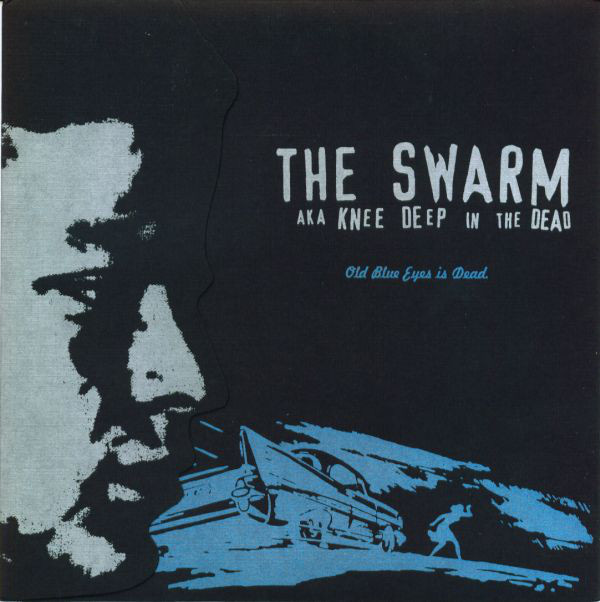
The Swarm aka Knee Deep in the Dead - Ol Blue Eyes is Dead 7”

There's a ton of overlap between vinyl and comic book collectors (mostly smelly, mostly male) and the punk & hardcore scene has taken a cue from the superhero industry: Variants! All told, there are at least four separate pressings of short-lived Canadian hardcore band The Swarm's 2nd release, Ol Blue Eyes is Dead. Their label, No Idea, currently offers FOUR different vinyl colors, and if you order a green one, you can ask for it without a center label, which is... cool? I guess? The songs are fine, though I’m troubled by the picture of the guitarist playing a semi-hollowbody guitar in the liner notes. It’s not like specific guitars are meant for certain genres, but… ok yes they are. You can’t play a semi-hollowbody guitar in a grindcore band just like you can’t play a nylon string guitar in a death metal band (some have tried, to varying degrees of failure). The record comes in a die-cut sleeve that, in theory, should be easy to slip the record back in, but Icarus may have flown too close to the sun for this packaging. To be honest, I've listened to this record maybe 3 times in my life, and each time getting the whole shebang back in the sleeve is a task worthy of Hercules.

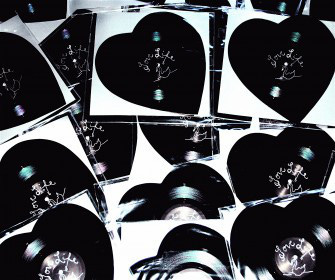
Love Life - Be Kind to Me/Hex it Out 7”

Different colored vinyl pressings makes for more work for the press operators, but nothing quite grinds their teeth like oddly-shaped vinyl. 31g, record label owned by vinyl-loving Locust member Justin Pierson (more on him later), pressed this spooky 7” on heart-shaped vinyl, more than a decade before Lana del Rey put out a heart-shaped vinyl single direct to Urban Outfitters locations. If you want a slab of early 00s goth soul, pick it up on the 31g website, for $5 it’s about $400 less than Lizzy Grant’s lil retail tie-in.

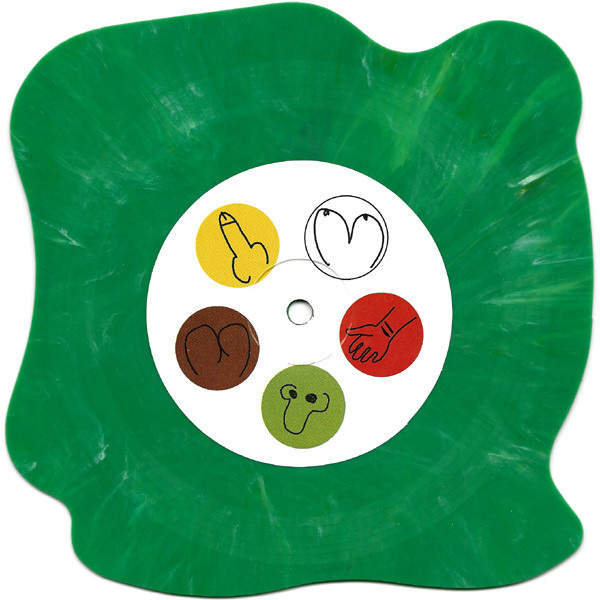
Locust/Arab on Radar split 7”

In hindsight it’s obvious that a split from 2 bands known for singing about bodily functions would release a split 7” shaped like a puddle of bodily fluid, but in person it’s even grosser than you can imagine. Neil Burke’s artwork may do a lot of the dry-heave heavy lifting, but seeing that green (or yellow, of course) vinyl spinning on a turntable is bound to bring up memories of past food poisoning. Leave it to Justin Pierson to release something that, while completely unmarketable, succeeds in letting the casual record buyer exactly what it’s inside the package.

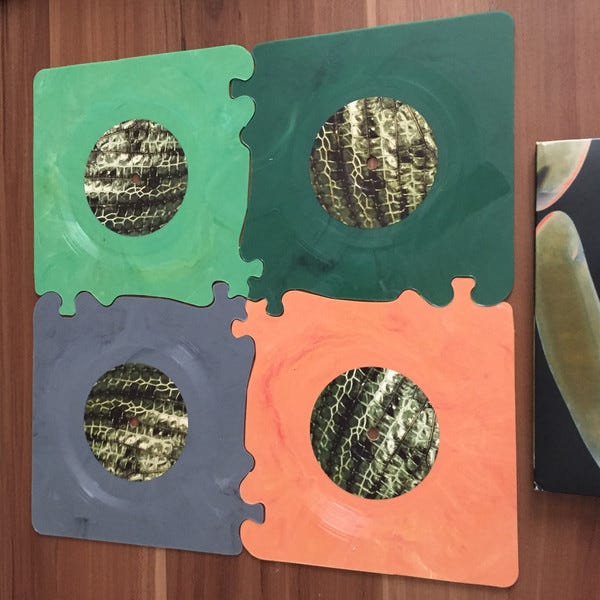
The Locust - Flight of the Wounded Locust 7”

Another entry from the world of Justin Pearson, not only was this the Locust’s first foray into songs longer than a minute, the collector’s version came in a package of four vinyl records that fit together like a puzzle. The end result was nothing spectacular, though it must have been difficult getting the dies cut just right so the pieces of plastic (prone to warping, shrinking, and expanding) fit together in at least a semi-satisfying way.

Acrid/Left for Dead - Hacked to Pieces split 12”

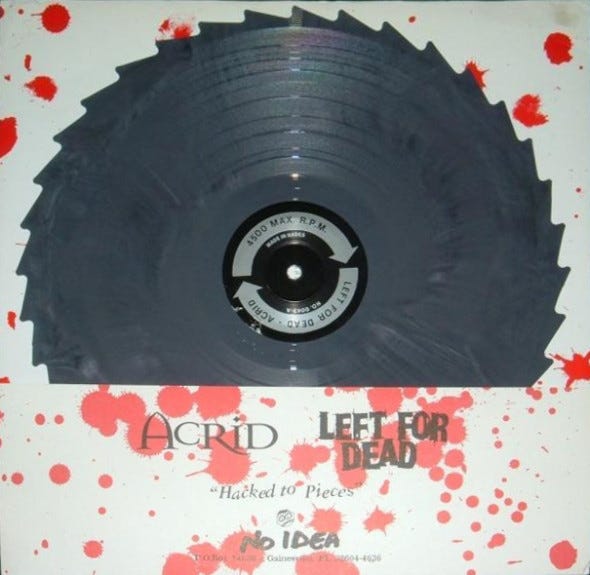
Most bands in the extreme end of metal and punk share the common idea of releasing a record shaped like a circular saw. It makes sense, right? Both are circles, and saws are metal as hell. Few go through with it, but No Idea (remember them?!) managed to not only pull it off, they did it in such colorful variants as Urine, Baby Blue, and uh.. Grayish-Purple. Listen, it’s shaped like saw, just buy it you nerd.

Less Than Jake - Cheese 7”

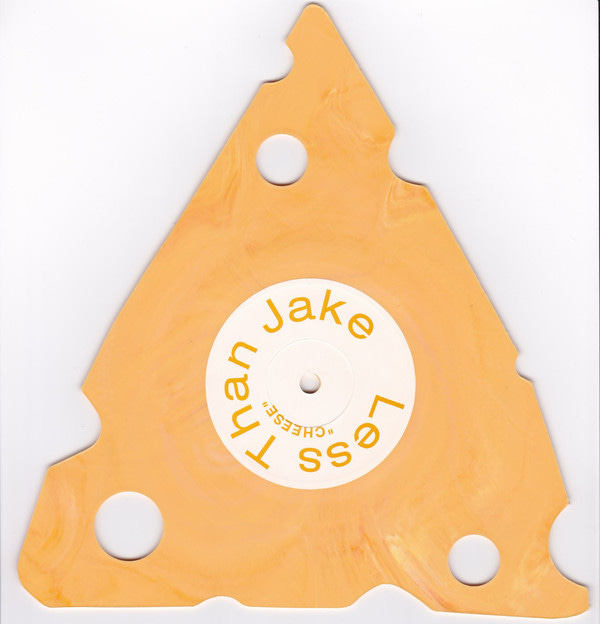
Pez is an early gateway for the budding collector kid, coming in every shape and color imaginable (or license-able), so it’s no surprise that Florida’s premier Pez-obsessed ska-punk band would dive headfirst into the collectable vinyl world. The die-cut Cheese 7” isn’t even their first foray into packaging gimmicks: 1995s Rock-N-Roll Pizzeria came in a 7”-sized pizza box with custom printing. Cheese stands out as the only vinyl record I’ve ever seen with more holes than the center spindle, but by 1998 the band had major label money, and drummer Vinnie Fiorello’s label Fueled by Ramen was gaining steam as it was becoming a near-ubiquitous pop punk mainstay.

Les Savy Fav - 7” series (collected on CD as Inches)

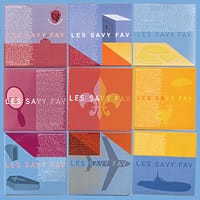
While not the cash-grab of gimmicky vinyl, the NYC post-punk weirdos did manage to create a secret, satisfying conclusion to their (nearly) yearly 7” releases: Assemble all 9 in a 3x3 pattern, and you get one giant cover! Naturally the Voltron cover was used for the CD compilation, but spacing out a gag over six years, on different labels and different levels of success, takes some dedication.